All throughout the Arab world, the despots are on the run.
Fueled by Facebook and Twitter, the Arab street is aflame.
In the United States, instead of fueling the resistance, social media is like a hypnotic drug.
A young Arab in Tunisia gets slapped around – the story goes – by a police officer.
He lights himself on fire.
And the whole Arab world is engaged.
Here in the United States, we get slapped around daily by the corporate elite.
And we take it sitting down in front of our computers.
Case in point.
Ronald Flanagan is a Vietnam Vet in Thornton, Colorado.
Ronald and his wife Frances have health insurance from Ceridian Cobra Services.
Their month premium – $328.69.
Frances went on line to pay their monthly premium.
By accident, she types in $328.67.
Two cents short.
Guess what our pals at Ceridian did?
Exactly.
Dropped the policy.
It came at a bad time for the Flanagans.
And a good time for Ceridian.
Ron has been fighting multiple myeloma – a cancer of the bone marrow – since September 2008.
“The nurses were just getting ready to do the biopsy when my wife popped into the office and told them, ‘Stop. We don’t have any insurance,’” Ron told ABC News 7 in Denver.
“And that’s when they let me know that we no longer had insurance on account of the two cents, and they canceled us,” Frances said. “Since then, I’ve been depressed. I haven’t been able to hardly do anything. As you can see, we still have our Christmas decorations up. So it’s been hard on me.”
Because of the two-cent mistake, Ceridian Cobra Services will not pay for the procedure.
We know that Ron is not alone.
We know that 45,000 Americans die every year due to lack of health insurance.
We know a person in our community in West Virginia who was diagnosed recently with a life threatening illness.
This person was six months away from being eligible for Medicare.
This person had no health insurance.
So, this person waited until reaching Medicare eligibility – 65 – before beginning treatment.
Apparently there are thousands of Americans between 60 and 65 in this dilemma.
They wait.
And many of them die as a result.
Earlier this month, we called a community meeting at the Earth Dog Cafe in Berkeley Springs, West Virginia to talk about the corporate control over our lives.
To discuss – among other things – getting rid of the health insurance corporations.
And replacing them with a single payer system.
Everybody in.
Nobody out.
About 75 people showed up on a Wednesday night.
It wasn’t Facebook or Twitter that brought people out.
It was about 100 phone calls.
Talking person to person about Americans dying from lack of health insurance.
Talking person to person about $700 million dollars a day being spent on wars that the majority of Americans don’t want.
Talking person to person about the need for community action.
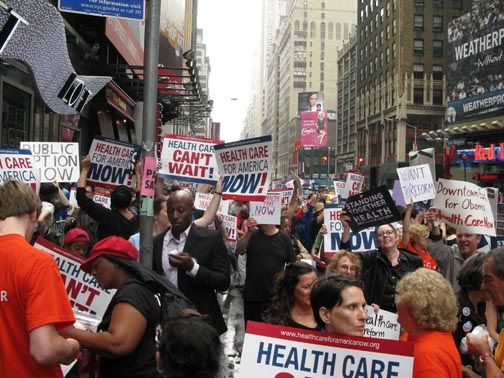
To stand up against the corporate slapdown of the American people.
We agreed to meet regularly – at least once every month.
ACTION NEEDED TODAY: Democratic House leaders can insert what is called a "Manager’s Amendment" into legislation, even when it is closed to any other amendments. The managers are the majority and minority members who "manage" debate for the bill on each side.
Today, tomorrow, and beyond, we need to call these "managers" and insist that the Kucinich Amendment is restored into the healthcare bill.
The "gang" that holds our future in their hands - the people you need to call NOW - are:
NOTE: When talking to Waxman and Pelosi's offices be sure to also tell them you want the vote on the Weiner Amendment she and Waxman promised on July 31st - We also need and have a right to see the CBO scoring on the Weiner Amendment.
I am told that if the leadership does not confirm 218 "solid" yes votes by the end of the 9:30 a.m. Democratic caucus meeting tomorrow morning, they will probably include the negotiated rate public option in the bill that is sent to the floor, not the Medicare +5% public option. At the very latest, we have until 2 p.m. to get the votes.
Note that "the list" is at the bottom of this post or in PDF format here.
If you member of Congress is on the list, call and leave a message tonight. We have to get through before 9:30 a.m., if possible.
If your member of Congress is not on the list , but you are represented by a Democrat, call your member of Congress and urge them to support the Medicare +5% option at the caucus meeting tomorrow morning.
If you are represented by a Republican, call either a member of the Democratic leadership or a Representative on the list who is from your state.
Call and leave a message. The campaign could really go either way depending on what happens in the next 14-18 hours.
---
The leadership and Democratic Caucus will be meeting Friday morning to determine which version of the Public Option they will include in the House bill.
Nancy Pelosi has said that she believe they have 218 representatives on board for a good public option. That means that they are only 12-15 votes away from the strongest version of the bill - the Medicare Plus 5 version that ties public option rates to Medicare reimbursement rates.
We desperately need the strongest possible House bill going in to conference with the Senate if the final bill is going to help us at all.
As soon as you get up in the morning, please make calls to the following "leaning" Dems. [Set your alarm a bit early so you will have time to call before leaving for work!]
It takes longer to get through - but if you need to, use this 800 number so there will be no cost to you:
1-800-828-0498
These are Representatives we believe are considering supporting the Medicare Plus 5 version. The first number is their DC office, the others are their district office numbers - thanks to Chris and mcjoan at Daily Kos for pulling this information and the the numbers together.
* Ron Klein (FL-22): 202-225-3026, 561-544-6910
* Dennis Moore (KS-03): 202-225-2865, 913-621-0832, 913-383-2013
* Stephen Lynch (MA-09): 202-225-8273, 617-428-2000
* Bob Etheridge (NC-02): 202-225-4531, 919-829-9122, 919-829-9122
* Dina Titus (NV-3): 202-225-3252, 702-387-4941
* John Boccieri (OH-16): 202-225-3876, 330-489-4414
* Steve Driehaus (OH-1): 202-225-2216, 513-684-2723
* Charles Wilson (OH-06): 202-225-5705, 740-633-5705, 330-533-7250
* Christopher Carney (PA-10): 202-225-3731, 570-585-9988, 570-327-1902
* John Sprat (SC-05): 202-225-5501, 803-327-1114
* Ruben Hinojosa (TX-15): 202-225-2531, 956-682-5545, 361-358-8400
* Solomon Ortiz (TX-27): 202-225-7742, 956-541-1242, 361-883-5868
Additionally, it never hurts to put some pressure on leadership. Most of these committee chairs haven't yet committed precisely because they're the committee chairs negotiating with leadership, but they need to hear from us as well to know the strength of public support for the strongest public option possible.
* Steny Hoyer (MD-05): 202-225-4131, 301-474-0119, 301-843-1577
* Chris Van Hollen (MD-08): 202-225-5341, 301-424-3501
* Jim Clyburn (SC-06): 202-225-3315, 803-799-1100
* John Larson CT-01): 202-225-2265, 860-278-8888
* Henry Waxman CA-30): 202-225-3976, 323-651-1040
* Chuck Rangel (NY-15): 202-225-4365, 212-663-3900
Below the is the full list of Dems who haven't fully committed one way or the other on the public option and on the most robust public option possible.
The Weiner amendment [PDF] --will be submitted for a floor vote in the House, in the coming days, - This will be a historic vote - the fist time ever Single-Payer has gotten a floor vote.
The Kucinich amendment, [PDF] which will more easily allow states to implement single-payer plans, is already within the bill and must be retained.
Passing these amendments will be difficult, but the votes on them will help set the benchmarks for the next debates on health care so they really do matter. Win or lose, we’ll know who our friends in Congress are...
Sen. Bernie Sanders is sponsoring a Medicare for All bill in the Senate, S. 703. Tell your Senators to support it; find contact info here. He has said that he will be introducing amendments to the Senate Health Care bill, so keep your eyes and ears open for them.
Why it is important to keep fighting for real Health Care Reform:
The New York Times reported on Saturday, October 17, that Sen. Ron Wyden (D-OR) is warning his constituents that the “public option” is not going to be available to the great majority of Americans. No one who has actually read the Senate health committee’s “reform” bill or the House “reform” bill (HR 3200) disputes this. According to the Congressional Budget Office, the “option” will be available only to about 30 million people, or about one American in ten. As the Times put it (slightly inaccurately), the “option” in the Democrats’ legislation “would be out of bounds to the approximately 160 million people already covered through employers.”
Does the public understand this? According to Wyden, they don’t. Wyden says his constituents are shocked when they are told the "option" will not be available to the vast majority of Americans. When he began informing his constituents about this truth last summer, "They nearly fell out of the bleachers," he said.
Once a bill is passed and signed by President Obama, voters will start to learn just how little help the current reform policies will provide. While it is probable that the reforms will continue to funnel money to the Health Insurance companies to fund their lobbying machines, the relief for citizens maybe too little and/or too complicated and I don't believe anything currently being offered will be sustainable in the long term. So we will come back to this table. And that is why good support for the current Single Payer amendments to H.R. 3200 in the House are critically important.
1. Google has built a site where you “explore the potential impacts of climate change on our planet Earth and find out about possible solutions for adaptation and mitigation, ahead of the UN’s climate conference in Copenhagen in December.” They’ve got a Google Earth mashup, a introductory video featuring Al Gore, and more. Visit: Climate change in Google Earth
2. Climate change is a human issue. It isn’t just about saving the planet and communities around the world face serious threats from the climate crisis. The TckTckTck campaign has created a great tool for learning the stories behind the human face of climate change. It’s called the Climate Orb and it is an animated interactive tool housing first-hand stories searchable by country, keyword and timeframe. Explore the Climate Orb.
3. There’s a lot more to solving the climate crisis than just sitting back and leaving it to world leaders and policy wonks to figure everything out. Need inspiration? Meet Alec Loorz, the creator of Kids vs. Global Warming. He describes it as “group of kids that educate other kids about the science of global warming and empower them to take action.” The site shows that everyone really can play a role in tackling climate change.
4. Just the facts, that’s what some people want—as long as there are lots of cool charts, graphs and clear explanations of course. That’s what’s great about the Pew Center for Global Climate Change’s "Facts and Figures" site, it is filled with all the charts and graphs you need to get a much clearer picture of what causes climate change and what effects it has. If you want even more information you can also check out their entire Climate Change 101 series.
5. At this point you’ve probably heard of “carbon footprints” and you might have even used an online calculator to figure out what yours is (and thus what your impact is on climate change). The problem is that there are just so many calculators out there now it can be hard to figure out which one to use. Thankfully you can learn about your options from MNN’s 15 Best Carbon Calulators survey.
6. OK, but how will climate change affect you? What are the consquences that are mostly likely to impact your day-to-day life? Take a look at this list of The Top 100 Effects of Climate Change. From “Say Goodbye to Pinot Noir” to “More Bear Attacks” to “Malaria Spreading in South America” to “More Stray Kitties” it seems like climate change is going to have a lot of consequences, some big, some not so big.
7. On the other side of the coin, you might want to be a little more optimistic and review the science behind “10 Solutions for Climate Change” which details what we can actually do to solve these problems personally and as a larger society.
8. Finally, don’t forget that people all around the world are getting involved and taking action.
On Monday October 5th, Drs. Margaret Flowers and Paul Hochfeld led a delegation of 15 physicians and nurses to the White House gate. The occasion was a Rose Garden ceremony with over 100 physicians in white coats invited, a photo-op to showcase support among doctors for the President’s effort at health reform.
Dr. Margaret Flowers, Congressional Fellow of Physicians for a National Health Program, was later contacted by one of the doctors allowed in the gates. The following is her response:
Don’t let the good be the enemy of the perfect
Thank you for inviting me to this conversation. I understand your concern to get some type of reform now. I hear your desperation. I have felt it myself. There is so much suffering that it is tempting to say – we must get something even if we know it is not the solution.
At some point we have to look at the facts that incremental change and compromise when it comes to health reform in this nation have not gotten us anywhere. While SCHIP is great, it has merely held the level of uninsured children at bay, not decreased it. Medicaid expansions have similarly not been able to keep up with the rising uninsured or been able to provide a financially sustainable and high quality solution. Why is this?
It is because the greatest impediment to health reform in this country is that the for profit (and not for profit in some cases, such as BCBS) health industries control the political process. No amount of incremental reform will change that. Regulation of the industry is expensive and has been ineffective. The industry can do an end-run around regulation so fast that it would make your head spin. With the proposed legislation, we will be throwing more money into an already overpriced and dysfunctional situation. We will delay enactment of better reform while we wait to see if this reform works, all the time knowing that it won’t. In the meantime, thousands of people will die unnecessarily, thousands of people will suffer, families will continue to go bankrupt and lose their homes, physicians will continue to leave practice.
Single payer was not supposed to be on the table this year, yet despite having little in the way of funding and no paid organizers (like HCAN has), we were able to move it forward and break through some of the media blackout through perseverance and dedication.
We must ask ourselves, how long are we willing to play the incremental game (knowing that while a few more get access to healthcare, many more continue to be left out)? When will we decide that we’ve reached the tipping point, and like other social justice movements, dig in and do the necessary work to enact change?
I am tired of hearing that we can’t have single payer or that it is not on the table. It will never be on the table and we will never get it until we do the work to put it there. We, as physicians (and the other health professionals), hold a unique position in society. For the most part we are seen as advocates for our patients and acting in the best interest of our patients (although sadly this vision is truer for nurses than for doctors). We are seen as "experts." Thus, I believe that it is our professional responsibility to educate and advocate for effective reform. If we work together we can create real change. But it is harder than showing up for a photo shoot. It takes a lot of time and travel and writing and speaking and money and a willingness to put our bodies on the line.
Until more of us are willng to do this, we will have to continue to settle for crumbs. I am not willing to settle for crumbs. My part in this drama is to be a strong voice for single payer. And I won’t give in until we get there. The stories that I hear from patients and docs keep me going. Nobody should be left out. Everybody should have the same level of care. It is our responsibility to fight for this. Anything less is unacceptable.
My two cents, for what it’s worth.
Respectfully,
Margaret
Additional comments from Dr. Andrew Coates:
Single-payer advocates should take note. Dr. Hochfeld was allowed to attend the ceremony, uninvited and at the last minute, because single payer cannot be ignored. Our persistence has proven effective. The goal of the mainstream discussion, orderly consensus for incremental change, with nary a ripple of discord, as remained elusive. Yet experience proves again and again that single payer swims just below the surface.
All year long it has become more and more clear – to more and more people – that single payer national health insurance is in fact the very least we need when it comes to health care reform that will work to improve our lives. As Dr. Flowers explains, "Anything less is unacceptable."
This just-below-the-surface dynamic, combined with clear and persistent advocacy, that has taken single payer from "off the table" to "on the floor" this year. We now learn that the vote on HR 3200 – and with it, the Weiner amendment that would substitute single payer legislation for the text of the bill – may be imminent. Activists around the nation are pulling out all the stops.
So the single payer presence within the beltway continues, even now, to increase, not diminish. We also recognize that soon we will begin a new chapter in our efforts to educate and advocate for a single-payer national health program.
While media coverage of the health reform debate is focused on the Senate Finance Committee's bill (which was largely drafted by current and former executives at Wellpoint, the nation's largest private health insurance company), several portentous congressional votes on single-payer Medicare-for-All loom on the horizon.
You can help determine the outcome of these votes, which are truly without historical precedent.
Quick Actions:
[Note that the text in the messages needs a bit of updating since it is now Oct. and we need to add a request for a CBO scoring of HR-676 in the one for the Weiner Amendment]
1. In the House - Ask your representative to support the Weiner and Kucinich amendments
Sometime in the next two or three weeks, Rep. Anthony Weiner's (D-N.Y.) amendment to substitute single-payer legislation (along the lines of Rep. Conyers' H.R. 676) for the House leadership's bill, H.R. 3200, will come up for an up-or-down vote on the House floor.
This is the first time single payer will have been put to a full floor vote in our nation's history, and it presents us with a unique opportunity to hold our representatives accountable on this issue. While the individual mandate approach to reform embodied in the Senate Finance bill would leave 25 million Americans uninsured, single payer would assure coverage for every American, as even President Obama has admitted. (You can find the number of people uninsured in your congressional district here.)
Additionally, Rep. Dennis Kucinich (D-Ohio) has secured a provision in H.R. 3200 that would allow individual states to adopt their own single-payer systems.
Contact your representative today and ask him or her to vote "YES" on the Weiner Amendment for single payer and insist that the Kucinich amendment remains in the final House bill..
The Congressional Switchboard number is (202) 224-3121.
2. In the Senate
Sen. Bernie Sanders (I-Vt.) will introduce two single-payer amendments to the Senate bill, one to create a national single-payer plan (along the lines of S. 703), and the other to allows individual states to adopt single payer.
Urge your senators to vote "YES" on the Sanders' single payer amendments.
The Congressional Switchboard number is (202) 224-3121.
Political figures, commentators and editorial writers are now routinely citing the study's finding of 45,000 deaths annually in their discussions of our health care crisis. Even Sen. Max Baucus has cited it, erroneously asserting that "[my] bill would fix that." (Actually, his bill would leave some 25 million uninsured, which translates into about 25,000 deaths annually.)
PNHPer and "Mad as Hell Doctor" Dr. Paul Hochfeld was admitted at the last minute to Obama's press event with physicians Monday and appeared on Keith Olbermann's "Countdown" show on MSNBC. The Mad as Hell Doctors, led by Hochfeld and Dr. Mike Huntington, wound up their 26-city, nationwide tour with a rally in Washington, D.C., on Sept. 30. They received extensive regional press.
Register today for PNHP's Annual Meeting on Saturday, Oct. 24, in Cambridge, MA, at the Royal Sonesta Hotel. Guest speakers include Dr. Marcia Angell, former editor of the New England Journal of Medicine; Harvard health economist William Hsiao, Ph.D.; journalist T.R. Reid; Sen. Bernie Sanders and Rep. Anthony Weiner and more. You won't want to miss this extraordinary gathering!
On September 29th in New York City, the Mobilization for Health Care for All is launching a national campaign of "Patients Not Profit" sit-ins at insurance company offices to demand an end to a system that profits by denying people care. We want the real "public option": Medicare for All, a single payer plan that cuts out the profit and puts patients first.
Insurance companies are the real death panels in America. They make billions in profit and millions for their CEOs while millions of Americans have no health insurance and over 45,000 die every year because they can't get the care they need. That's more than 120 people every day. These insurance companies deny care to their members and the American people for profit.
America deserves better, and that's why we voted for change. But the insurance companies are spending millions to confuse and scare the public to keep us from ending their grip on our health and our money. With teabagger town hall protestors and the right-wing noise machine on their side, they're winning. We can't let that happen. It's time to take the fight to the real villain in the health care debate.
When the civil rights movement faced a similar challenge in the struggle to end segregation, nonviolent civil disobedience moved the nation and made reform possible. Just like the lunch counter sit-ins did for the civil rights movement, we have to make it impossible for the media and our country to ignore how outrageous the status quo of private insurance is for the American people.
It only takes a small group of people to do a sit-in in your community, but our actions can inspire every American who has been abused by the insurance companies and believes it's time for real reform to fight for it. This campaign of nonviolent civil disobedience will continue until the insurance companies no longer stand between the American people and the health care that is our right.
Already, doctors, nurses, patients, and people just like you are signing up to be one of the 100 ordinary but courageous people who will launch this nonviolent battle to end private insurance abuse and win health care for all. Join us! We can't wait any longer - every day more people die because of the insurance company death panels. Sign Up!
When votes start getting cast, those who vote against a public option will generate the kind of ire that Wilson received, and activists will look for ways to punish those corporatist Democrats. Primary challengers are already being recruited in several Blue Dog districts, and votes against reform will generate additional impetus for more primaries. And while ordinary Americans will never be able to outraise the insurance industry and their millions of bribe dollars, they can generate enough money to wage credible campaigns.
Consequently, Blue Dogs should worry about being in the mainstream of their constituents. For example, Rep. Jim Cooper in the Tennessee 5th congressional district has been a longtime foe of real healthcare reform. Yet a Research 2000 poll for Daily Kos found that only 31 percent of respondents would vote to reelect him. Asked if they approved of his actions on healthcare, just 31 percent approved, including just 16 percent of Democrats. All told, 61 percent supported a public option, while just 28 percent opposed it.
Progressive activists are itching for primary challenges to reduce the influence of corporatist Democrats in Congress. Blue Dogs can either solidify their electoral standing by voting on behalf of their constituents, or they can invite primary challenges funded by the party’s well-connected and engaged progressive base.
Join us in Washington D.C. September 24th, 4:30 pm for the 3rd Annual Health Care Justice Vigil
In solidarity with American Patients United's 3nd Annual Health Care Justice Vigil in Washington DC, single-payer/Medicare For All healthcare activists are organizing solidarity vigils from New York City to the state of Washington. Also, the G20 Summit will take place in Pittsburgh on September 24-25, and provides another opportunity for single payer activism.
The events uphold a deeply important time for those who have lost someone to the broken U.S. healthcare system, or who are still fighting the denials of the for-profit health insurance companies.
Healthcare justice activists will join together reaching across the country to support each other and remember those who have been lost. We will post vigil details from around the country as they come in.
Obama's Wednesday night speech reassured the Democratic base that the President is deeply committed to getting universal coverage. But the speech also made clear that the White House has decided to side with the Senate Finance Committee and against the Democratic base on the details. The President was careful to note that a public option is only a means to an end and he remained open to other ideas (read: Conrad's cooperatives or Snowe's trigger). The speech included nothing about Medicare bargaining leverage, thereby letting the drug deal stand. The President clearly sided with Senate Finance on the funding mechanism of a tax or fee on high-end insurance rather than a surtax on the wealthy. And his promise to limit the costs of universal coverage to $900 billion put the President directly in league with the Senate Finance Committee rather than than the House, whose bill is projected to cost more than $1 trillion.
The Dem leadership got the message. Yesterday, Senate majority leader Harry Reid said that while he favored a strong public option, he could be satisfied with establishment of nonprofit cooperatives. And Nancy Pelosi, who as recently as two weeks ago said the House would not support a bill that didn't include a public option, passed up a chance to say it was a nonnegotiable demand. When pressed, she said that as long as legislation makes quality health care more accessible and affordable, "we will go forward with that bill."
But, again, the race has just begun. Your input is still important -- in fact, more important now than before.
The single best thing you can do is to (politely) communicate with your elected representatives about healthcare. Tell them your personal stories. Make them understand why you support reform and why you think the stakes are so high. They need to hear from their constituents, and the people who make the effort to talk to them in person will be heard most loudly.
A spokesman for America's Health Insurance Plans, the industry's trade group, admitted in an article published Monday that as many as 50,000 industry employees are involved in an effort to fight back against aggressive healthcare reform.
The admission, published in the last sentence of a Wall Street Journal article, highlights the stakes of potential healthcare reform for the private health insurance industry. Insurers and investors alike are terrified at the prospect of a so-called “public option,” which would create a government-run health insurance program to compete with private insurers. Because the government plan wouldn't have to earn a profit, the plan would be able to undercut the premiums of private firms, pressuring profit margins.
Robert Reich, the former Labor secretary, scholar and commentator, called Tuesday for a "march on Washington" on Sept. 13 —"Grandparents Day" — in support of a health care bill that offers a public option.
While he said organizing was not his strength, he would be prepared to assist. "If enough people feel that's the best way for their voices to be heard, and can't be heard in any other way, then we march," Reich said in a reader question-and-answer session in POLITICO's Arena.
A group of conservatives have already announced a "tea party" movement march on Washington for Sept. 12. An opposing march the next day, if one were to materialize, could make for an interesting weekend.
Reich's suggested march is the latest manifestation of liberal anger about signs that the Obama administration may be willing to live without a public option if it means a health care bill can become law. "Very few things happen in Washington that are in the public's interest when corporations have huge financial stakes in the game, as they obviously do with health care — unless the public is actively involved, engaged and organized," Reich wrote. "We won't get a public option, or anything close to it, unless people who feel strongly about it make a racket."
The "first step is to be very loud and very vocal: Write, phone, e-mail, your congressional delegation and the White House. Second step: Get others to do the same. Third step: Get voters in Montana, North Dakota, Nebraska, and other states where Blue Dog Dems and wavering Senate Dems live, and have them make a hell of a fuss. Fourth step: March on Washington."
He suggested the morning of Sept. 13 because "that's a Sunday, and it's also Grandparents Day. I've just become a grandparent, and I'm worried as hell about the kind of world my little granddaughter is inheriting."
August 13, 2009 -- Frustrated with the health care 'options' coming out of Washington, D.C., six "Mad as Hell" Oregon physicians are taking an unprecedented road trip across America to lobby Congress for a single-payer health care system. A big part of their plan is to take the entire country with them.
Called a "Care-A-Van," these road-tripping Oregon physicians will leave in a used motor home from Portland, Oregon on September 8th, inviting doctors and ordinary citizens from other states to join them on their twenty-city tour across the country. Their journey will culminate in a D.C.-based event on September 30th, scheduled to take place on the steps of Congress. Demonstrating with the doctors will be thousands of fellow 'Mad as Hell' single-payer advocates, all adorned with the movement's new symbol - the white ribbon. Their demand: Single-Payer Now!
"We're mad as hell because our health care system is run by people who profit from illness" says Dr. Paul Hochfeld, lead Mad As Hell Doctor and producer of the documentary 'Health, Money and Fear.' "The rest of the civilized world has test driven single payer and it works. But elected officials in America won't even allow a discussion."
"The public option is a trap." Hochfeld continues. "It sounds very reasonable, but the problem with it, no matter what the final bill looks like, is that it will continue to allow private medical insurance companies to dictate America's public health policies. And that's just plain wrong."
Several national, single-payer advocacy organizations including Physicians for a National Health Program, Health Care Now, Single Payer Action, and even groups like Progressive Democrats of America and Jobs with Justice are supporting the Oregon physicians by setting up Mad as Hell Town Halls across the country in anticipation of their arrival.
"People need to understand what single-payer is--and isn't," says Dr. Mike Huntington, a radiologist from Corvallis, Oregon and fellow Mad As Hell Doctor. "It isn't Socialism, any more than police and fire are Socialism. And it doesn't require any more money. Simply put, single-payer is a way to take current premium payments that go to a thousand different private insurance companies, and redirect them into a single, public fund that insures everyone. That's all it is. But when we do this, lots of wonderful things happen, not the least of which is to save Americans 500 billion dollars a year starting day one. That's billion - with a 'b.' America needs this information. That's why we're taking the tour."
Reality Television meets Political Activism
Every move the Mad as Hell Doctors make will be recorded on camera and then edited and uploaded to the Internet that same day. The uploaded segments will appear on social networking web sites such as Facebook, Twitter, YouTube, MySpace, et al, making the Mad As Hell Doctors Tour the first of its kind: an unprecedented hybrid of reality television and political activism.
"We're doing this because we care," declares Dr. Gene Uphoff, a family physician from Portland, Oregon and fellow Mad As Hell Doctor. "The time to demand that a Single Payer Plan be put on the table is now. We may not get another opportunity for real change like this in our lifetime. Washington needs to hear all of us right now."
Hochfeld agrees. "This isn't a campaign. It's a movement. Join us."
What the country needs--what Obama needs, whether he realizes it or not--is an independent, mobilized, progressive citizens' movement that takes on the corporate lobbies, from Big Pharma to Big Oil to Wall Street; challenges the legislators who are in their pockets; and demands affordable national healthcare, renewable energy, empowerment of workers, regulation of Wall Street and more. That movement should go after the conservatives and the compromised in both parties--anyone who stands in the way of reform.
The obstruction by Republicans and the right is real and must be opposed. But so should the back-room guile of the moneyed lobbies and their Democratic allies. If we are going to get the change we need, progressives will have to challenge those in both parties who can't see which way the wind is blowing.