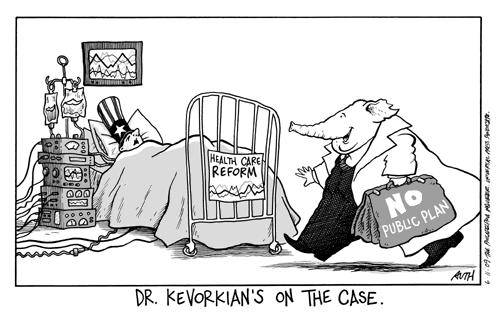
Reid says he’s moving forward with a Senate bill that has a public option with an opt-out in it "with the support of the White House, and Senators Dodd and Baucus." He says that the Senate bill will also have co-ops included - which confuses me a bit. My hope is that he is not considering the co-ops a public option. And of course, just who will be allowed to participate in the Public Option is still fuzzy. So while we don't know just what the Public Option will look like, the best news is that we don't have the "trigger" deeply disappointing Olympia Snowe.
Fueling the push for a new government insurance plan, Senate Majority Leader Harry Reid (D-Nev.) said today that his chamber's healthcare bill would include a compromise that would create a nationwide public option but give states the right to opt out.
"The public option is not a silver bullet, [but] I believe it's an important way to ensure competition and to level the playing field for patients with the insurance industry," Reid said. "Under this concept, states will be able to decide what works for them."
Reid sent the proposal to the nonpartisan Congressional Budget Office to be analyzed today, a key step before he can bring a bill to the floor for debate.
His decision does not settle the debate roiling Democratic ranks over how to create a government plan that would give consumers who don't get coverage through their employers an alternative to plans offered by commercial insurers.
The "opt-out" compromise is still two votes shy of the 60 Reid needs to overcome a Republican filibuster, according to a senior Democratic aide on Capitol Hill who requested anonymity when discussing the plan.
Reid and House Speaker Nancy Pelosi (D- San Francisco) are advancing separate healthcare bills in the Senate and House, which would have to be reconciled later this year before they are sent to the White House for President Obama's signature.
But Pelosi indicated Friday that the opt-out alternative could be included in a reconciled bill.
For now, House Democrats are poised to pass a bill that would create a nationwide government plan, although there is still disagreement about how much such a plan should pay doctors, hospitals and other medical providers.
Liberals, including Pelosi, favor a proposal that would link those payments to the existing Medicare program, which often pays providers less than commercial insurers. Proponents believe such an arrangement would save money and help drive down costs.
But many conservative Democrats, particularly from rural areas where Medicare typically pays less, want the government plan to negotiate its rates with providers, as commercial insurers do.
Pelosi hopes to settle those differences in time to unveil a bill later this week, according to her office.
Democrats on a key Senate Committee outlined a revised and far less costly health care plan Wednesday night that includes a government-run insurance option and an annual fee on employers who do not offer coverage to their workers.
The plan carries a 10-year price tag of slightly over $600 billion, and would lead toward an estimated 97 percent of all Americans having coverage, according to the Congressional Budget Office, Sens. Edward M. Kennedy and Chris Dodd said in a letter to other members of the Senate Health, Education, Labor and Pensions Committee. The AP obtained a copy.
By contrast, an earlier, incomplete proposal carried a price tag of roughly $1 trillion and would have left millions uninsured, CBO analysts said in mid-June.
The letter indicated the cost and coverage improvements resulted from two changes. The first calls for a government-run health insurance option to compete with private coverage plans, an option that has drawn intense opposition from Republicans.
"We must not settle for legislation that merely gestures at reform," the two Democrats wrote. "We must deliver on the promise of true change."
Additionally, the revised proposal calls for a $750 annual fee on employers for each full-time worker not offered coverage through their job. The fee would be set at $375 for part-time workers. Companies with fewer than 25 employees would be exempt. The fee was forecast to generate $52 billion over 10 years, money the government would use to help provide subsidies to those who cannot afford insurance.
The same provision is also estimated to greatly reduce the number of workers whose employers would drop coverage, thus addressing a major concern noted by CBO when it reviewed the earlier proposals.
Kennedy, D-Mass., and Dodd, D-Conn., circulated their letter a few days before lawmakers return from their July 4 vacation, with the Health Committee one of several panels expected to take action on health care legislation that President Barack Obama has placed atop his domestic agenda.
Kennedy, the committee chairman, was diagnosed with a brain tumor more than a year ago and has been absent from the Senate for weeks, although he and his aides have been heavily involved in the deliberations on a health care bill. Dodd, the next senior Democrat on the committee, has presided at committee sessions and taken an increasingly public role.
With its government option, the proposal is unlikely to gain any bipartisan support in the committee.
Separately, Democrats and Republicans on the Senate Finance Committee are at work trying to reach agreement on an alternative that calls for creation of nonprofit cooperatives to sell insurance in competition with private industry. Agreement has been elusive on that and other issues, and it is not clear whether a deal is possible before Democrats opt for a more partisan approach.
In their letter, Kennedy and Dodd said the Congressional Budget Office "has carefully reviewed our complete bill, and we are pleased to report that CBO has scored it at $611.4 billion over 10 years, with the new coverage provisions scored at $597 billion. ...The completed bill virtually eliminates the dropping of currently covered employees from employer-sponsored health plans.
"In addition, our bill, combined with the work being done by our colleagues in the Finance Committee, will dramatically reduce the number of uninsured — fully 97 percent of Americans will have coverage, a major achievement."
Three committees in the House have been at work for weeks on a plan expected to come to a vote by the end of July.
Call Sen. Dodd, who is Kennedy's standard-bearer on this one, and tell him you want Single Payer, but if not that, a robust Medicare like public option must be included in the draft that goes to markup:
Tel: (202) 224-2823 | Fax: (202) 224-1083.
You can also e-mail the committee: help_comments@help.senate.gov.
While you're at it, here's the rest of the Democrats on the committee:
Capitol Hill Toll Free Number: 800-828-0498
Tom Harkin (IA): (202) 224-3254
Barbara A. Mikulski (MD): (202) 224-4654
Jeff Bingaman (NM): (202) 224-5521
Patty Murray (WA: (202) 224-2621
Jack Reed (RI): (202) 224-4642
Bernard Sanders (I) (VT): (202) 224-5141
Sherrod Brown (OH): (202) 224-2315
Robert P. Casey, Jr. (PA): (202) 224-6324
Kay Hagan (NC): (202) 224-6342
Jeff Merkley (OR): (202) 224-3753
Help the HELP committee help all of us, by telling them you want Medicare for All- Single Payer and that they must hold the line on a Medicare like public option.
While you're at it, call the White House at (202) 456-1414.
And keep on calling Baucus, Waxman and Rangel as well as your own Senators and Representative.
Dropping in at 615 pages is the Senate Health, Education, Labor and Pensions Committee's attempt to fix the broken health care system. The HELP Committee is chaired by Sen. Ted Kennedy (D-Mass.). The second-ranking Democrat, Sen. Chris Dodd of Connecticut, had a large hand in drafting the bill as well, given Kennedy's absence from the committee while he battles brain cancer.
The bill can be read here. {PDF} A HELP Committee aide cautioned that the bill is not in its final form and that part of the reason for filing it is to meet a committee rule that requires a bill to be filed seven days before a vote can be held.
Committee Democrats will be meeting with their Republican counterparts Wednesday and Thursday to hash out the bill's details.
Senator Chris Dodd (D-CT) joined Dr. Mohammad Akhter, Executive Director of the National Medical Association and Dana Tillman, a victim of the health care crisis, at a press conference this morning to discuss the economic impact of skyrocketing health care costs.
Senator Chris Dodd asks: Is your health care working? What changes would you like to see?
Democratic Senators are writing a major health reform bill. Rising costs are hitting families and businesses and now 46 million Americans live without health coverage. We need reform. Respond now with your ideas as the Senate writes health care legislation. You can help.