From Kaiser Health News
"Despite spending more than twice as much as other developed countries, the United States still lags behind in terms of access and quality, an international survey said Wednesday," Agence France-Presse reports. The Health Affairs study, which was based on survey responses from thousands of primary care physicians, also found that people in the United States were more likely to struggle to gain access to or pay for treatment than patients in 10 other countries evaluated because of insurance restrictions and high health care costs. "The United States is the only industrialized democracy that does not ensure that all of its citizens have health care coverage, with an estimated 36 million Americans uninsured," the French news agency reports (11/5).
The Seattle Post Intelligencer's travel writer shares the views of some residents of other developed countries on their native health systems. A person from Sweden – one of the countries covered in the Health Affairs survey – says, "The health and medical services have an obligation to strengthen the situation of the patient, for example, by providing individually tailored information, freedom to choose between treatment options, and the right to a second opinion in cases of life-threatening or other particularly serious diseases or injuries. Having lived here all my life and raised my family here in Stockholm, I honestly do not see anything bad with our health care system" (Steves, 11/4).
The most important health-care document released this week was not Sen. Max Baucus's Healthy Future Act. It was the Kaiser Family Foundation's 2009 Employer Benefits Survey.
While the proposal by Baucus, chairman of the Senate Finance Committee, outlines a direction for policy, the survey, which polls employers about health benefits to assemble a detailed look at the actual cost of health care, fits it squarely in our pocketbooks.
The truth is we all pay, and much more than we recognize, for health care.
For many, it's among the largest investments we'll make, on par, even, with the money we spend on a house or tuck away for retirement. But while it's easy to track our stock portfolios as they tank along with the market, our outlay for health care is less obvious. Employers pay some, and so do individuals, and taxpayers. And some even hides behind the deficit. As such, few of us see the full picture. But to make sense of the proposals for reform, getting a grasp of the cost is critical.
The average health-care coverage for the average family now costs $13,375, according to Kaiser. Over the past decade, premiums have increased by 138 percent. And if the trend continues, by 2019 the average family plan will cost $30,083.
Three years of slightly above-average health insurance will cost a solid six figures.
Those are numbers to marvel at. Those are numbers to fear. But they are not the numbers that loom in the minds of most Americans. And therein lies the problem for health-care reform.
About 160 million Americans receive health coverage through their employers. In general, the employer picks up 73 percent of the tab. This seems like a good deal. In reality, that money comes out of wages.
As Ezekiel Emanuel, who advises Office of Management and Budget Director Peter Orszag on health-care policy, has pointed out, health-care premiums have risen by 300 percent over the past 30 years (and that's after adjusting for inflation). Corporate profit per employee has soared by 200 percent. Hourly earnings for workers, adjusted for inflation, have fallen. The wage increases have been consumed by health-care costs.
Another 80 million Americans are on public plans, mainly Medicare and Medicaid. Those costs are paid by taxpayers. And about 46 million Americans are uninsured. The costs for their care are shifted to the insured: This raises premiums for the average family by $1,100 each year, according to an analysis by Ben Furnas and Peter Harbage of the Center for American Progress.
Imagine if people who touched a hot stove felt only a small fraction of the pain from the burn. That's pretty much what's happening in our health-care system. It hurts enough that we would prefer it to stop, but the urgency is lost. Read it all at the Washington Post.
Lack of health insurance now more lethal
One American now dies every 12 minutes from lack of health insurance.
FOR IMMEDIATE RELEASE Sept. 17, 2009 Contacts: Steffie Woolhandler, M.D., M.P.H. David Himmelstein, M.D. Andrew P. Wilper, M.D., M.P.H. Mark Almberg, Physicians for a National Health Program, (312) 782-6006, mark@pnhp.org David Lerner or Karmen Ross, Riptide Communications, (212) 260-5000 A study published online today estimates nearly 45,000 annual deaths are associated with lack of health insurance. That figure is about two and a half times higher than an estimate from the Institute of Medicine (IOM) in 2002. The new study, "Health Insurance and Mortality in U.S. Adults," appears in today’s online edition of the American Journal of Public Health. The Harvard-based researchers found that uninsured, working-age Americans have a 40 percent higher risk of death than their privately insured counterparts, up from a 25 percent excess death rate found in 1993. Lead author Dr. Andrew Wilper, who worked at Harvard Medical School when the study was done and who now teaches at the University of Washington Medical School, said, "The uninsured have a higher risk of death when compared to the privately insured, even after taking into account socioeconomics, health behaviors and baseline health. We doctors have many new ways to prevent deaths from hypertension, diabetes and heart disease — but only if patients can get into our offices and afford their medications." The study, which analyzed data from national surveys carried out by the Centers for Disease Control and Prevention (CDC), assessed death rates after taking education, income and many other factors including smoking, drinking and obesity into account. It estimated that lack of health insurance causes 44,789 excess deaths annually. Previous estimates from the IOM and others had put that figure near 18,000. The methods used in the current study were similar to those employed by the IOM in 2002, which in turn were based on a pioneering 1993 study of health insurance and mortality. Deaths associated with lack of health insurance now exceed those caused by many common killers such as kidney disease.An increase in the number of uninsured and an eroding medical safety net for the disadvantaged likely explain the substantial increase in the number of deaths associated with lack of insurance. The uninsured are more likely to go without needed care. Another factor contributing to the widening gap in the risk of death between those who have insurance and those who don’t is the improved quality of care for those who can get it. The research, carried out at the Cambridge Health Alliance and Harvard Medical School, analyzed U.S. adults under age 65 who participated in the annual National Health and Nutrition Examination Surveys (NHANES) between 1986 and 1994. Respondents first answered detailed questions about their socioeconomic status and health and were then examined by physicians. The CDC tracked study participants to see who died by 2000. The study found a 40 percent increased risk of death among the uninsured. As expected, death rates were also higher for males (37 percent increase), current or former smokers (102 percent and 42 percent increases), people who said that their health was fair or poor (126 percent increase), and those that examining physicians said were in fair or poor health (222 percent increase). Dr. Steffie Woolhandler, study co-author, professor of medicine at Harvard and a primary care physician in Cambridge, Mass., noted: "Historically, every other developed nation has achieved universal health care through some form of nonprofit national health insurance. Our failure to do so means that all Americans pay higher health care costs, and 45,000 pay with their lives." She added: "Even the most liberal version of the House bill would have left 17 million uninsured, according to the Congressional Budget Office. The whittled down Senate bill will be worse — leaving tens of millions uninsured, and tens of thousands dying because of lack of care. Without the administrative savings only attainable through a Medicare-for-all, single-payer reform — real universal coverage will remain unaffordable. Politicians are protecting insurance industry profits by sacrificing American lives." Dr. David Himmelstein, study co-author and an associate professor of medicine at Harvard, remarked, "The Institute of Medicine, using older studies, estimated that one American dies every 30 minutes from lack of health insurance. Even this grim figure is an underestimate — now one dies every 12 minutes." "Health Insurance and Mortality in U.S. Adults," Andrew P. Wilper, M.D., M.P.H., Steffie Woolhandler, M.D., M.P.H., Karen E. Lasser, M.D., M.P.H., Danny McCormick, M.D., M.P.H., David H. Bor, M.D., and David U. Himmelstein, M.D. American Journal of Public Health, Sept. 17, 2009 (online); print edition Vol. 99, Issue 12, December 2009. A copy of the study, along with a state-by-state breakout of excess deaths from lack of insurance, is available at http://www.pnhp.org/excessdeathsPhysicians for a National Health Program ( www.pnhp.org) is a research and educational organization of 17,000 doctors who support single-payer national health insurance. To speak with a physician/spokesperson in your area, visit www.pnhp.org/stateactions or call (312) 782-6006. Source: Physicians for a National Health ProgramA full text copy of the study, published in the American Journal of Public Health is here (PDF). A state-by-state breakout of excess deaths from lack of insurance, is available here (PDF)
More From Dr. Steve:There are 11 million Americans with chronic physical illnesses like heart disease, diabetes and asthma are not getting the medical care they need because they don’t have health insurance. The uninsured have higher rates of stroke and cardiovascular disease deaths. The American Cancer Society found that uninsured cancer patients are nearly twice as likely to die within five years as those with private coverage.
Overall, the United States has the highest rate of so-called "amenable" mortality among 19 OECD countries; that's 101,000 fewer deaths per year if we were as good as the average of the top three. But forget studies and just think for a moment. It matters if you got the mammogram last year, or get "treated" in the ER for untreatable metastatic breast cancer today. It matters if you if get your lipids checked and started on statins five years ago because you have coverage, or get "treated" in the ER for your fatal heart attack today. Let me be a little bit more clear. This attitude by right wing Republican idealogues is not just delusional, it is homicidal. They are justifying the deaths of tens of thousands of Americans. That is the equivalent of seven 9/11's per year, year-in and year-out.
Hospitals are getting killed financially in part because of the dumping of care into emergency rooms. They are closing ERs all over the country because of this. Meanwhile wait times in the ER are up even for the critically ill. This is not new news. Everyone who knows anything about health care in the country knows this.
And let's not forget that half of personal bankruptcies are linked to health care costs (admittedly the studies on this predate the mortgage crisis; though of course right-wing free-market fundamentalist privatization and deregulation led to that disaster too). Of course that includes lots of people "with" health insurance from the same private for-profit health insurance companies
The main thrust of the anti-reform argument is that government is bad at running things, and would be terrible at running a healthcare program. Better to entrust running healthcare to the very same private insurers who have gotten rich creating the very problem we have now: skyrocketing premium costs, coverage reductions or limitations, denials due to pre-existing conditions, etc.
But is there really a good argument to be made against government run healthcare plans in general? Certainly, the healthcare enjoyed by members of congress is government-run, as is that offered to our armed servicemen and women. How do they measure up to privately run medical programs?
A team of researchers recently set out to compare the quality of VHA care with that of care in a national sample by using a comprehensive quality-of-care measure. From the study, the research team concludes that patients receiving socialized, government-run medicine from the VHA received higher-quality care according to a broad measure. Differences were greatest in areas where the VHA has established performance measures and actively monitors performance.
What this study really says is that the more accurately we measure, the more we begin to see that socialized, government-run medical programs like the VA provide extremely high quality medical care Read it all here.
The American health care system puts patients at greater risk of harm from medical or surgical errors than patients elsewhere and ranks behind the top countries in extending the lives of the elderly. It has a mixed record on preventive care — above average in vaccinating seniors against the flu, below average in vaccinating children — and a mixed record of caring for chronic and acute conditions.
Contrary to what one hears in political discourse, the bulk of the research comparing the United States and Canada found a higher quality of care in our northern neighbor. Canadians, for example, have longer survival times while undergoing renal dialysis and after a kidney transplant. Of 10 studies comparing the care given to a broad range of patients suffering from a diverse group of ailments, five favored Canada, three yielded mixed results, and only two favored the United States. Read it all at NYTimes.com
Press Release: Medical problems contributed to nearly two-thirds (62.1 percent) of all bankruptcies in 2007, according to a study in the August issue of the American Journal of Medicine that was published today online. The data were collected prior to the current economic downturn and hence likely understate the current burden of financial suffering. Between 2001 and 2007, the proportion of all bankruptcies attributable to medical problems rose by 49.6 percent. The authors’ previous 2001 findings have been widely cited by policy leaders, including President Obama. Surprisingly, most of those bankrupted by medical problems had health insurance. More than three-quarters (77.9 percent) were insured at the start of the bankrupting illness, including 60.3 percent who had private coverage. Most of the medically bankrupt were solidly middle class before financial disaster hit. Two-thirds were homeowners and three-fifths had gone to college. In many cases, high medical bills coincided with a loss of income as illness forced breadwinners to lose time from work. Often illness led to job loss, and with it the loss of health insurance. Even apparently well-insured families often faced high out-of-pocket medical costs for co-payments, deductibles and uncovered services. Medically bankrupt families with private insurance reported medical bills that averaged $17,749 vs. $26,971 for the uninsured. High costs – averaging $22,568 – were incurred by those who initially had private coverage but lost it in the course of their illness. Individuals with diabetes and those with neurological disorders such as multiple sclerosis had the highest costs, an average of $26,971 and $34,167 respectively. Hospital bills were the largest single expense for about half of all medically bankrupt families; prescription drugs were the largest expense for 18.6 percent. The research, carried out jointly by researchers at Harvard Law School, Harvard Medical School and Ohio University, is the first nationwide study on medical causes of bankruptcy. The researchers surveyed a random sample of 2,314 bankruptcy filers during early 2007 and examined their bankruptcy court records. In addition, they conducted extensive telephone interviews with 1,032 of these bankruptcy filers. Their 2001 study, which was published in 2005, surveyed debtors in only five states. In the current study, findings for those five states closely mirrored the national trends. Subsequent to the 2001 study, Congress made it harder to file for bankruptcy, causing a sharp drop in filings. However, personal bankruptcy filings have soared as the economy has soured and are now back to the 2001 level of about 1.5 million annually. Dr. David Himmelstein, the lead author of the study and an associate professor of medicine at Harvard, commented: "Our findings are frightening. Unless you’re Warren Buffett, your family is just one serious illness away from bankruptcy. For middle-class Americans, health insurance offers little protection. Most of us have policies with so many loopholes, co-payments and deductibles that illness can put you in the poorhouse. And even the best job-based health insurance often vanishes when prolonged illness causes job loss – precisely when families need it most. Private health insurance is a defective product, akin to an umbrella that melts in the rain." "For many families, bankruptcy is a deeply shameful experience." noted Elizabeth Warren, Leo Gottlieb Professor of Law at Harvard and a study co-author. Professor Warren, a leading expert on personal bankruptcy, went on: "People arrive at the bankruptcy courts exhausted—financially, physically and emotionally. For most, bankruptcy is a last choice to deal with unmanageable circumstances." According to study co-author Dr. Steffie Woolhandler, an associate professor of medicine at Harvard and primary care physician in Cambridge, MA: "We need to rethink health reform. Covering the uninsured isn’t enough. Reform also needs to help families who already have insurance by upgrading their coverage and assuring that they never lose it. Only single-payer national health insurance can make universal, comprehensive coverage affordable by saving the hundreds of billions we now waste on insurance overhead and bureaucracy. Unfortunately, Washington politicians seem ready to cave in to insurance firms and keep them and their counterfeit coverage at the core of our system. Reforms that expand phony insurance - stripped-down plans riddled with co-payments, deductibles and exclusions – won’t stem the rising tide of medical bankruptcy." Dr. Deborah Thorne, associate professor of sociology at Ohio University and study co-author stated: "American families are confronting a panoply of social forces that make it terribly difficult to maintain financial stability—job losses and wages that have not kept pace with the cost of living, exploitation from the various lending industries, and, probably most consequential and disgraceful, a health care system that is so dysfunctional that even the most mundane illness or injury can result in bankruptcy. Families who file medical bankruptcies are overwhelmingly hard-working, middle class families who have played by the rules of our economic system, and they deserve nothing less than affordable health care." "Medical bankruptcy in the United States, 2007: Results of a national study," David U. Himmelstein, M.D; Deborah Thorne, Ph.D.; Elizabeth Warren, J.D.; Steffie Woolhandler, M.D., M.P.H. American Journal of Medicine, June 4, 2009
----------------------------------------------------------------------------------------- Medical Bankruptcy – Q&A 1 - What is a "medical bankruptcy"? A number of medical factors can contribute to a family’s financial collapse, including high medical bills or lost time from work. Because different researchers use different definitions, we supplied a detailed analysis of debtors who: • Specifically identified medical problem of the debtor or spouse (32.1%) or another family member (10.8%) as a reason for filing bankruptcy.
• Specifically said medical bills were a reason for bankruptcy. (29.0%)
• Lost two or more weeks of wages because of lost time from work to deal with a medical problem for themselves or a family member. (40.3%)
• Mortgaged their homes to pay medical bills. (5.7%)
• Spent more than $5,000 or 10% of annual household income in out-of-pocket medical bills (34.7%) • Total, one or more of the above criteria: 62.1% The vast majority (92%) of bankruptcies that we classified as medical had medical bill problems as indicated by: listing medical bills as a specific reason for their bankruptcy; or having medical bills of bills $5,000 or 10% of household income or that forced them to mortgage their home. The remaining 8% whose bankruptcy was classified as "medical" indicated that a medical problem or income loss due to illness was a cause of bankruptcy. 2 - Why do only 29% of bankrupt people identify medical bills as a reason for filing bankruptcy, but you say the total percentage of medical bankruptcies is 62.1%? Families characterize their problems differently. Someone may mortgage a home to pay for surgery, then be unable to pay off the mortgage, describing the reason for filing bankruptcy as "unable to pay the mortgage." Similarly, some people explain that they have lost too much time from work when they have taken off to care for a child who has been hospitalized. We believe that multiple ways of asking about medical bankruptcies give the most complete picture, but we publish the breakdown in responses so that any other research or commentator can draw his or her own conclusions. Finally, it should be noted that many people who are financially ruined by illness are undoubtedly too ill, too poor or demoralized to pursue formal bankruptcy, and are not counted in our study. 3 - What is the impact of health insurance? More than three-quarters (78%) of the families that met the criteria for medical bankruptcy had health insurance at the onset of their illness or accident. By comparison, 80% of the non-elderly adult population and 85% of the entire U.S. population had health insurance in 2007. Hence, it appears that health insurance offers only modest protection against medical bankruptcy. 4 - Is the problem of medical bankruptcies just because of the recession? No. The families in this study filed for bankruptcy between January-April of 2007, before the recession began. Since then, the financial stress on families has grown. 5 - Is this a national sample of all families filing for bankruptcy? Yes. The sample was drawn from bankruptcy filings across the country. 6 - How did you get your information? We contacted a random sample of all personal bankruptcy filers in the U.S. during the winter of 2007. Written questionnaires were returned by 2,314 debtors, and we also analyzed their bankruptcy court records. We also carried out extensive telephone interviews with 1,032 of these debtors. Finally, to be sure that the debtors who returned our survey were similar to those who did not, we also analyzed the court records of 99 of the non-respondents. They were almost identical to those who returned the survey in terms of debts, income, assets and other characteristics. 7 - What’s the basis for saying that the proportion of bankruptcies that are medical rose by 50% between 2001 and 2007? In order to compare the medical bankruptcy rates in 2007 and in our 2001 study we had to use the same definitions in both years. Our 2001 study had used a less stringent ("legacy") definition of medical bankruptcy that included families with more than $1000 in unpaid medical bills. Using this "legacy" definition, the medical bankruptcy rate rose from 46.2% in 2001 to 69.1% in 2007 – a 49.6% increase. The 2001 estimate relied on data collected from bankruptcy filers in five states. Analysis of the 2007 data confirmed that the five states included in the 2001 survey also saw a 50% increase in medical bankruptcies. 8 - Would health reform eliminate the problem of medical bankruptcy? Many debtors described a complex web of problems involving illness, work, and family. Separating medical from other causes of bankruptcy is difficult. Hence, we cannot presume that eliminating the medical antecedents of bankruptcy would have prevented all of the filings we classified as "medical bankruptcies." The high rate of insurance among the medical bankrupts suggests that any health reform that fails to improve existing private coverage is unlikely to make a major impact on medical bankruptcy. Moreover, our data also highlight the need for improved disability coverage. 9 - Why do some others claim that medical bankruptcy rates are much lower? Ours is the only study based on direct surveys and interviews with a large sample of families filing for bankruptcy. Others have based their findings on bankruptcy court records alone (with no direct surveys or interviews) or on surveys of the general public that inquire about bankruptcy filings. Court records fail to identify medical bankruptcies because many medical bills are charged to credit cards and hence cannot be identified as "medical" in court records. Similarly, when medical providers turn debts over to collection agencies they would not appear as "medical." Because bankruptcy carries a substantial stigma, about half of all respondents who are bankrupt deny that fact. As a result, surveys of the general public are an unreliable source of information on medical bankruptcy. For these reasons, the only way to accurately assess medical bankruptcy is to directly survey families who file for bankruptcy. ------------------------------------------------------------------------------------------------- Medical Bankruptcy – Fact Sheet • In May 2009, more than 5,000 families filed for bankruptcy every business day. For all of 2009, the total is expected to reach about 1.4 million. The average personal bankruptcy involves 2.71 debtors and dependents. In total, an estimated 3.8 million Americans will be involved in personal bankruptcy filings this year. • Illness and medical bills were a cause of at least 62.1% of all personal bankruptcies in 2007. Based on the current bankruptcy filing rate, medical bankruptcies will total 866,000 and involve 2.346 million Americans this year – about one person every 15 seconds. • Using identical definitions in both years, the proportion of bankruptcies attributable to medical problems rose by 49.6% between 2001 and 2007. • Most medically bankrupt families were middle class before they suffered financial setbacks. 60.3% of them had attended college and 66.4% had owned a home; 20% of families included a military veteran or active-duty soldier. • Most medical debtors had some health insurance, but many suffered gaps in coverage: 77.9% of the individuals whose illness led to bankruptcy had health insurance at the onset of the bankrupting illness; 60.3% had private insurance.
69% of debtor families had coverage at the time of their bankruptcy filing
60% of families had continuous coverage
Only 0.3% of the uninsured went without coverage voluntarily, i.e. because they though they didn’t need it – most others couldn’t afford it.
• Among medical debtors, hospital bills were the largest medical expense for 48% drug costs for 19%, doctors’ bills for 15% and insurance premiums for 4%. In 38% of cases, lost income due to illness was a factor. • Out-of-pocket medical costs since the onset of illness averaged $17,943. - For the privately-insured, out-of-pocket costs averaged $17,749.
- For the uninsured, out-of-pocket costs averaged $26,971.
- Patients with neurologic disorders such as multiple sclerosis faced the highest costs, and average of $34,167, followed by diabetics at $26,971.
• According to earlier studies, between 7.1% and 14.3% of Canadian bankruptcies are due to "health/misfortune" (a category that includes some non-medical problems). -------------------------------------------------------------------------------------------------------- Downloadable copies of press release and info above is at the PNHP website here. And again, downloadable full text of professional peer review journal article is here. ---------------------------------------------------------------------------------------------------------- More: In addition to whatever else your minimal demand is, mine is for what would seem to be a non-radical, non-shrill, non-extremist minimal demand, and one that some senators and congresscritters claim to have agreed to (but need pressure to help them keep them promise):
"There must be a complete, honest, side-by-side comparison of all proposals, including single payer HR-676 (Conyers) and SB-703 (Sanders), by the Congressional Budget Office. The side-by-side comparison should include projected costs to state governments, employers and to households of different income levels. For 2010 and beyond."
Because the only way to actually control costs and provide universal and comprehensive coverage is single payer. It is crticial that whatever it is we are going to be allowed to get, and whatever it is we are not getting, be honestly and transparently compared for all to see: The best we have for now is the January 2009 report from the Commonwealth Fund done by the Lewin Group comparing congressional proposals, as summarized in their graph and table below: - "Stark"=Single Payer (expanded and improved Medicare for All)
- "Building Blocks" = Obama/Baucus (mandates to buy private for-profit health insurance + real Public Option + expanded Medicaid)
Total Change in National Health Expenditures, in 2010 (in Billions) Under Different Health Reform Proposals: 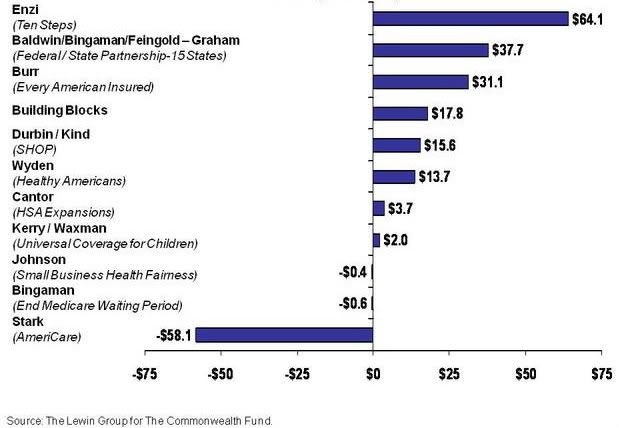
and Change in Health Spending by Stakeholder Group, Billions of Dollars, 2010 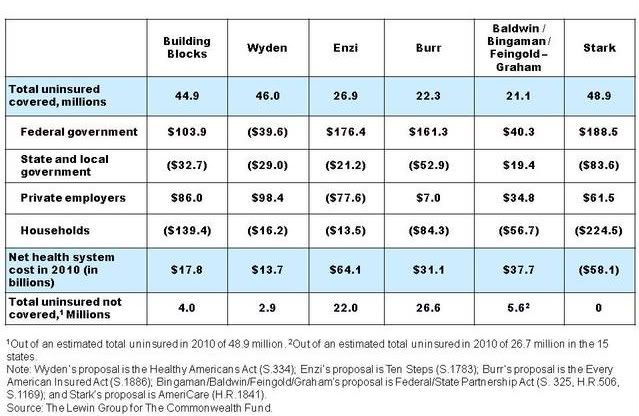
That is why Senator Baucus keeps asking the CBO to "fix the numbers."
Call these critical Democratic Senators, and let your voice be heard:
- Senator Max Baucus at (202) 224-2651
- Senator Charles Schumer at 202-224-6542
- Senator Edward Kennedy at (202) 224-4543
- Senator John Rockefeller at (202) 224-6472
- Senator Ron Wyden at (202) 224-5244
- Senator Kent Conrad at (202) 224-2043
- Senator Jeff Bingaman at (202) 224-5521
- Senator John Kerry at (202) 224-2742
- Senator Blanche Lincoln at 202-224-4843
- Senator Debbie Stabenow at (202) 224-4822
- Senator Maria Cantwell at 202-224-3441
- Senator Bill Nelson at 202-224-5274
- Senator Robert Menendez at 202-224-4744
- Senator Thomas Carper at (202) 224-2441
Cross Posted from Daily Kos with a Hat Tip to Dr. Steve
In the United States, if you are sick and earn a modest income, then you are probably underinsured - even if you have employer-based health coverage. In 2007, among people at 200 percent of poverty ($41,300 for a family of four in 2007) who were among the top 25 percent of spenders on health care services, 71 percent were underinsured.
"U.S. families with health insurance are paying an estimated $1,017 more in annual premiums to compensate providers for healthcare to the uninsured, a report released on Thursday said." Read More....:
The Commonwealth Fund
Rising health care costs coupled with eroding health care benefits are having a substantial effect on Americans' ability to get needed health care, with women particularly affected. Women experience cost-related access problems and medical bill problems more often than men. In 2007, more than half (52%) of women reported problems accessing needed care because of cost and 45 percent of women accrued medical debt or reported problems with medical bills. Since women use more health care services than men, they are more exposed to the fragmentation and failings of the current health care system—underscoring the need for affordable and high-quality health insurance coverage that is available to all.
The Commonwealth Fund
In a national Commonwealth Fund survey, elderly Medicare beneficiaries reported greater overall satisfaction with their health coverage, better access to care, and fewer problems paying medical bills than people covered by employer-sponsored plans. The findings bolster the argument that offering a public insurance plan similar to Medicare to the under-65 population has the potential to improve access and reduce costs.
The McKinsey Quarterly - health care costs income disparity US - Economic Studies - Country Reports
Over the past 50 years, US workers have come to expect employers to pay for some part of employee health insurance; many consider this an important part of overall compensation. However, recent economic trends have resulted in a growing disparity in health care coverage and affordability. A study by the McKinsey Global Institute (MGI) identified three divergent categories of workers that are emerging from trends in health care coverage and income growth.
The top-income category (earning on average $210,100 annually1) has enjoyed rising incomes and growing employer-paid health care benefits, which have made their out-of-pocket spending on health care a relatively small and affordable portion of total spending. The higher-middle-income category (earning an average of $84,800 annually) and the lower-middle-income group (earning on average $41,500), have also seen increasing benefits and incomes—but at a much slower rate, making the uncovered portion of their health care costs ever-more expensive. In the bottom-income category (earning an average of $14,800 a year), incomes have been stagnant, and their employers are less likely to pay for their health insurance. This group is finding any health care difficult, if not impossible, to afford.
A new study came out today from the UC Berkeley Center for Labor Research and Education called 'No Recovery in Sight: Health Coverage for Working-Age Adults in the United States and California'. The report claims that half a million people in California have lost their health insurance coverage during the recession Controversial Issues:
1. Will everyone be required to buy health insurance? If so, that's called an "individual mandate". During the campaign, then candidate Obama objected to the idea of requiring all adults to get health insurance saying that he thought people would want to buy it if it was affordable but you wouldn't have to force them to do it. The California health reform effort last year failed in part because of concerns people had about an individual mandate -- but Massachusetts has one and so far it has worked pretty well.
2. How much will we have to pay to get coverage if a bill is passed? Will it be affordable? What is affordable anyway? For many families, $500 a month for a family premium breaks the bank and keeps food off the table. No one knows the answers to these questions right now.
3. Can we reform the health insurance industry so that they can't refuse coverage if you've ever been sick? That is called "medical underwriting" and "pre-existing conditions". Last week, America's Health Insurance Plans (AHIP) and the BlueCross BlueShield Association (BCBSA) wrote a letter to the president offering to drop those practices if everyone was required to have insurance. It's a start. They certainly didn't offer to do that back in 1993 when the Clintons were trying to reform health care.
4. A lot of people think that if we offer health plans to people who don't get insurance through their employers, that there ought to be a choice between a private insurance plan and some sort of publicly administered plan. That "public plan option" is being fiercely debated in Congress right now. The private insurance plans worry that they can't compete successfully with a public plan for a whole lot of reasons I won't go into here, so they are opposing it. Look for this to be huge source of debate in the next few months. But do yourself a favor -- do your homework about it and don't believe everything you hear, like it would be socialism or government telling your doctors what to do. Read about the public plan idea and see if it makes sense to you.
5. Should our health care benefits be taxed? Or should the portion our employers pay be taxed? This is a hot potato for sure. The problem with this idea is that there is a LOT of money to be collected by taxing the benefits of people who have insurance to help pay for those who do not. Very tricky.
These are just a few of the issues that will need to be resolved before we get health coverage for everyone. Despite the fact that this is complicated, all you need to do to answer your own questions is look around you -- do you know someone who has insurance but still can't get the care they need? People who are a paycheck away from losing what they have? People who have to rely on the emergency room because they have no other way to get care? If you do, then you understand the meaning of "No recovery in sight" UNLESS we pass health reform.
Medicare-for-All Would Create Jobs Throughout Economy, 2.6 Million New Jobs in Manufacturing, Retail, Health, and Other Sectors With President Obama preparing to present his budget proposal, which is expected to include both an update on his economic stimulus initiatives and a renewed call for healthcare reform, the nation's largest organization of registered nurses today released new data on how the most comprehensive healthcare fix would create new jobs in nearly all areas of the national economy. Overall, expanding and upgrading Medicare to cover all Americans (single-payer) would create 2.6 million new jobs, infuse $317 billion in new business and public revenues, and inject another $100 billion in wages into the U.S. economy, according to the study by the Institute for Health and Socio-Economic Policy (IHSP), research arm of the California Nurses Association/National Nurses Organizing Committee. The study may be viewed at www.CalNurses.org. While 30 percent of the new jobs would be in health and social services, the ripple effect of job creation goes throughout the economy, according to updated data released today. Biggest additional gains would be in retail trade, accommodation and food services, manufacturing, and administrative services. 
All these benefits could be achieved at less cost than the federal bailouts for Wall Street giants such as, AIG, CitiGroup, Fannie Mae and Freddie Mac, and other banks. "The new data reminds us that the most effective solution to our healthcare crisis would also provide a dramatic, immediate help towards economic recovery," said CNA/NNOC Co-President Geri Jenkins, RN. "The jobs creation that would come from a single-payer system is just one reason RNs know that single-payer is the right thing to do for our patients, for ourselves, and for our country." HR 676, a bill recently reintroduced in Congress, would implement a single-payer system. First of its kind study
The IHSP projections build from an econometric model of the current face of healthcare – applying economic analysis to a wide array of publicly available data from Medicare, the Bureau of Labor Statistics, Bureau of Economic Analysis, and other sources. It is the first known study to provide an econometric analysis of the economic benefits of healthcare to the overall economy, showing how changes in direct healthcare delivery affect all other significant sectors touched by healthcare, and how sweeping healthcare reform can help drive the nation's economic recovery. Healthcare presently accounts for $2.105 trillion in direct expenditures. But healthcare ripples far beyond doctors’ offices and hospitals. Adding in healthcare business purchases of services or supplies and spending by workers, the total impact of healthcare in the economy mushrooms to nearly $6 trillion. A single-payer system would produce the biggest increase in jobs and wages. The reason, says IHSP director and lead study author Don DeMoro said, is that "the broadest economic benefits directly accrue from the actual delivery and provision of healthcare, not the purchase of insurance." A Medicare-for-all system has numerous healthcare benefits as well, said CNA/NNOC, including: - A streamlined system that ends the irrational structure of our current system by replacing the chaos of different plans that have different rules for coverage, eligibility, exclusions, and charges.
- Slashing unproductive waste in the private insurance sector by $56 billion.
- Guaranteeing that everyone is covered, even if you lose or want to change your job; guaranteed choice of doctor and hospital; a standard set of benefits and care for everyone (no multi-tiered care system); no insurance denials based on pre-existing conditions or denials of treatment recommended by doctors because the insurer doesn't want to pay for it.
- Guaranteed health security for all Americans. No more rapidly rising premiums, co-pays, deductibles rising three or four times faster than wages, pushing more families into bankruptcy from medical bills, or self-rationing care because you can't pay for it.
- Economic protection for employers who see ever-rising costs, or who can't compete with employers based in countries with national healthcare systems.
The IHSP has conducted research for members of Congress and state legislatures as well as NNOC/CNA, and received international renown for research studies on cost and charges in the hospital industry, the pharmaceutical industry, hospital staffing, and other healthcare policy. Robert Fountain, a frequent economics consultant for the California Public Employees Retirement System (Cal-PERS), served as a consultant on the study. CNA/NNOC represents 85,000 RNs in all 50 states, and is a founding member of the newly formed United American Nurses-NNOC. Read the full study here.
Laurie Barclay, MD
February 13, 2009 -- US physicians increasingly support a single-payer national health insurance system, according to the results of a survey reported online January 29 in the Journal of General Internal Medicine.
"Many politicians may mistakenly believe that single-payer national health insurance lacks support among key stakeholders such as doctors," lead author Danny McCormick, from Harvard Medical School and Cambridge Health Alliance (CHA), said in a news release. "Our finding that support for single-payer national health insurance now approaches that of tax-based incremental reforms suggests that a Medicare-for-all-type plan may be more politically viable than conventional wisdom suggests."
The goal of this US nationally representative mail survey was to evaluate physician opinion regarding financing options for expanding coverage for and access to healthcare.
Between March 2007 and October 2007, US physicians involved in direct patient care were asked to rate their support for reform options such as financial incentives to encourage people to buy health insurance and single-payer national health insurance, as well as to rate their views of several aspects of access to healthcare.
Of 3300 physicians sent the survey, 1675 (50.8%) responded; 49% prefer either tax incentives or penalties to promote the purchase of health insurance; 42% prefer a government-run, taxpayer-financed single-payer national health insurance program, which increased from 26% in a study 5 years previously; and only 9% prefer the current, employer-based financing system.
Regarding access to healthcare, 89% of physicians surveyed believe that all Americans should receive needed medical care regardless of ability to pay; 33% believe that the uninsured currently have access to needed care; and 19.3% believe that even the insured lack access to needed care. Opinions regarding access were independently associated with support for single-payer national health insurance.
"Surveys show that a majority of Americans support a single-payer system. It's not surprising that increasing numbers of doctors do," said coauthor David Bor, MD, also from Harvard Medical School and Cambridge Health Alliance. "Single payer is the only proposal that can cover all Americans, for all needed care, without driving up healthcare costs. National health insurance would eliminate the massive administrative costs and hassles imposed by our current multiplicity of private insurers."
Limitations of this study include modest response rate; the possibility that physicians strongly interested in health policy issues may have been more likely to respond; lack of generalizability to all physicians' views; and possible misinterpretation of question meaning or bias related to question wording and response option content.
"Although a plurality of physicians favored incremental health care reform proposals based on the use of tax credits and penalties, a substantial proportion of physicians preferred an entirely different health care financing system -- a government-run, taxpayer-financed single-payer [national health insurance] program," the study authors write. "Physicians play a central role in the health care system and these views could be influential in reforming the financing of the American health care system."
The Department of Medicine at the Cambridge Hospital funded this study. The authors have disclosed no relevant financial relationships.
J Gen Intern Med. Published online January 29, 2009.
|