by Eddie C All the way back in 2002 there was a disturbing piece in the paper. It was in May of that year when USA Today mentioned the fact that "More than 18,000 adults in the USA die each year because they are uninsured and can't get proper health care." This story that some may find disturbing was printed when there was only 40 million uninsured Americans. With conservative estimates at 47 million now uninsured related deaths must have risen. According to one source the death toll was up to 22,000 by 2006. But even if the number stayed stagnate by the end of this year that means 144,000 dead Americans since 2002! Does 200,000 deaths during the first decade of the new millennium sound like a national emergency? In the richest nation on earth it sounds like the worst atrocity imaginable. The poor have Medicaid and the rich have money so those deaths could be called middle class genocide. Somebody or some group of people need to account for this but who do you blame? It is extremely obvious that empathy is in short supply because of a heartless media and gutless politicians setting the tone. A nation where military contractors are allowed to make budget decisions on the most efficient killing machines but doctors have their hands tied in making medical decisions is far worse than just broken. In order for the national debate to move forward we must first get the issue in perspective, someone is killing our people. Many progressives may feel that with a new popular president in office this is not the time for reality. Accountability would be counterproductive at a time when elected officials are finally in agreement that something must be done. How did we get to a point where more Americans seem to be upset about immigrants receiving free health care than this ongoing middle class genocide? Before assigning blame a little perspective is in order. How much media coverage did terrorism receive in the past decade and how much media coverage did Americans who just wanted to live but were not allowed to get? If more Americans were aware of the fact that in excess of 18,000 Americans per year are getting killed by a for profit industry would "Well we will never get anything done with Bush in office" still have been an excuse? 200,000 dead Americans through lack of coverage matches the disputed U.N. death toll in Darfur. The African genocide represents violent deaths often covered by the media with American politicians constantly talking about answers while 200,000 Americans die silently. Our own people have been ignored by our leaders and the media so their neighbors will not notice. Answers are now expected from the people who worked so hard to cover up the questions? Or a comparison could be made with Bush's personal war in Iraq that gets a whole lot of media coverage. Some politician's definition of progress is launching an imperialist war without a draft buteven the American death toll in Vietnam is far less that a third of our forgotten dead Americans. The number of Americans who have died in this sad American decade serving their nation by fighting a war in Iraq is a little over two percent of the Americans who have perished due to lack of health care. One could say that the 200,000 silent deaths and the 4,250 that have gotten American's attention are related in some death in the name of profit scheme but those forgotten Americans did not volunteer. The fact is that even when you add in the Iraqi deaths since America invaded the highest estimates are still only half the number of people who died due to lack of coverage. These forgotten Americans who have become a hidden statistic does sound like a violence against the people in the name of commerce but perhaps war deaths are not the proper comparison. Now that public outcry gave politicians an attitude adjustment the more than 18,000 uninsured who die each year is greater than the annual deaths in the U.S.A. from AIDS. The number of American who die from lack of health care doesn't even come close to smoking related deaths but smoking greatly contributes to the runaway cost of health care and the way our elected officials points to the morality of our leadership. At 440,000 deaths per year tobacco has proven to be the most toxic substance on earth but there is money to be made so the government went partners with the tobacco companies. In the interest of commerce cigarettes remain legal and our elected officials are patting themselves on the back over funding SCHIP through a cigarette tax. That's health care! Or how about the fact that on a list of leading causes of death for Americans between the ages of 55 and 64 being uninsured ranks third! In a nation that ranks forty-fifth in life expectancy we just went through a presidential election with no candidate addressing the issue of hard working Americans who are forced to detach from the workforce because of age. Nothing but silence, as I tried to point out in Medical Coverage: What about Americans between 55 and 64? So who should take the blame for all of these deaths? Another "Let's just forgive and forget" in America or placing the blame on a for profit industry that Barack Obama feels should stay in business is not the answer. Is it the health insurance companies that are killing Americans? I don't recall any health insurance company employees promising to serve the people. A great deal of blame has been placed on the AHIP but the lobbyist group are not public servents. Should we blame the actual insurance companies who are only committed to their shareholders? Blame the hospitals that administer treatment by the most expensive means possible or the elected officials who have refused to regulate hospitals? Should we blame the media where once again the service of the shareholders is the only priority? An honest look at what has gone on in this nation over the past fifteen years points to a truly despicable leadership. Were it not for the cover up of the many facts we would have change by now. Many advocates of H.R. 676 should have been given the opportunity to get on national television to reveal the many facts like the U.S. ranking last in preventing deaths from treatable conditions but honest and objective people were denied access to the debate. Instead elected officials were sitting across from media pundits fabrication stories about the horrors of medical treatment in Canada and France and the United Kingdom. Seriously with the amount of Americans dying from lack of health care this nation should be having celebrities on commercials telling the facts that have been limited to the progressive blogs. There should be Jerry Lewis style telethons for the suffering Americans. But I can't even remember a elected official bringing up the true facts that working Americans have been forced to face on national television. The invented negatives still seem to get a whole spin cycle in the drug company dependent media without a peep out of many of the signers of H.R.676. Why does it seem that only the progressive bloggers in this nation know the facts? Doesn’t it seem in the history of health care reform that H.R. 676 has never been anything more than a carrot on a string? The national debate has been slanted for far too long and the few Democrats in congress who sign a bill every two years that is never meant to leave committee don't get a pass. Not that they have all been silent all of the time but the few time that Dennis Kucinich has gotten on national television, the occasional Pete Stark C-SPAN sound bite and John Conyers sitting down every now and then talking with H.R. 676 advocacy groups has not gotten the message out. Outside of a new president have the players changed? Is the misrepresentation going to continue or will they be able to pass legislation that will end the insane spending and cut themselves off from the big campaign contributions that have kept a serious solutions off the table? The mendacity that has been fed to the American public is still causing damage today. In the previous election Barack Obama ran and won the presidency without advocating for health care for all. Neither candidate endorsed single payer health care but after all the pain a Democrat was still not ready. On the campaign trail the President promised a savings to the typical American family up to $2,500 in an still employer based health care plan where Americans will be able to transfer from job to job and the preexisting conditions will be done away with. Today he is talking about affordable health care for all and setting aside money for that possibility, some of it coming from cuts in existing federal medical assistance programs!
The officials said the resulting increase in revenues, estimated at $318 billion over 10 years, would account for about half of a $634 billion "reserve fund" that Mr. Obama will set aside in his budget to address changes in the health care system. The other half would come from proposed cost savings in Medicare, Medicaid and other health programs.
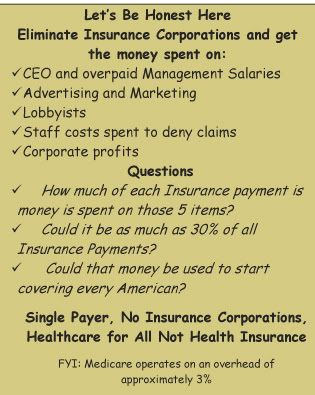
This is all so hard to digest since it is breaking news right now. But it sounds like a down payment to cover a for profit universal health care fund. Why does it seem like only the progressive bloggers understand that administrative waste accounts for roughly 31% of the money spent on health care and that America can afford H.R. 676? Yesterday DrSteveB wrote Health Reform and Costs - They Are Lying To You (Obama too) When will they stop lying? When will America get to the point where everyone knows that the only way to fix the medical disaster is to remove the profits? I really don't have any answers but one thing I do know is that the same people inside the beltway who claim to have the answers killed about 200,000 of my fellow Americans and I think that fact should see some light. The more light it receives, the more reality we will hear.
This blog has spent a lot of time over the years digging through the details of this or that health care plan. But it's worth taking a moment to appreciate that the language in today's budget is something entirely different: Not an idea, but a directive. Not a document to win a campaign, but a document to kickstart the congressional process.
This is what health reform looks like. This is happening.
As reported here earlier in the week, the budget document does not offer a detailed plan. Rather, it's partial funding paired with detailed principles. The money is significant: $634 billion over 10 years. It comes from limiting the itemized deductions upper income Americans can use to lower their tax bracket and squeezing the private insurance providers who are charging Medicare 114 percent what the program traditionally spends. It comes from accelerating the adoption of generic drugs and changing hospital payment policy to reduce the need for follow-up visits.
According to documents obtained by The Prospect, the budget also says that "the President looks forward to working with the Congress over the coming year, and as he does, the President will adhere to the following set of eight principles:"
• Guarantee Choice. The plan should provide Americans a choice of health plans and physicians. People will be allowed to keep their own doctor and their employer-based health plan.
• Make Health Coverage Affordable. The plan must reduce waste and fraud, high administrative costs, unnecessary tests and services, and other inefficiencies that drive up costs with no added health benefits.
• Protect Families’ Financial Health. The plan must reduce the growing premiums and other costs American citizens and businesses pay for health care. People must be protected from bankruptcy due to catastrophic illness.
• Invest in Prevention and Wellness. The plan must invest in public health measures proven to reduce cost drivers in our system—such as obesity, sedentary lifestyles, and smoking—as well as guarantee access to proven preventive treatments.
• Provide Portability of Coverage. People should not be locked into their job just to secure health coverage, and no American should be denied coverage because of preexisting conditions.
• Aim for Universality. The plan must put the United States on a clear path to cover all Americans.
• Improve Patient Safety and Quality Care. The plan must ensure the implementation of proven patient safety measures and provide incentives for changes in the delivery system to reduce unnecessary variability in patient care. It must support the widespread use of health information technology with rigorous privacy protections and the development of data on the effectiveness of medical interventions to improve the quality of care delivered.
• Maintain Long-Term Fiscal Sustainability. The plan must pay for itself by reducing the level of cost growth, improving productivity, and dedicating additional sources of revenue.
America's Economic Future Requires Health Care Reform - Maryland Commons: Interactive News & Commentary: "We are told reforming health care is impossible in tough economic times. However, it is not only possible, it is necessary for economic recovery.
Health care costs are rising 2.5 percent faster than the nation’s gross domestic product. At this rate, health care will consume as much as half of household income by 2018.
In a global economy, American businesses cannot compete when the cost of health care is so high. Does it make sense for the auto industry to spend more for health care than for steel?
The current situation is unsustainable; we must enact fundamental, comprehensive reform to create a system that works." There is a state bill called the Maryland Health Security Act (HB 1186, SB 881) and a national resolution called HR 676. Both would create a health system based on a single public payer. To learn more or become involved, go to www.mdsinglepayer.org and www.guaranteedhealthcare4all.org
It is time to set aside ideology and enact health care reform to provide everyone with continuous access to health care from birth to death, simply and less expensively. This is what a civilized society does.
Bluegrass Central Labor Council Endorses HR 676
Lexington, Kentucky. At its February meeting the Executive Board of the Bluegrass Central Labor Council voted to endorse HR 676, single payer health care legislation introduced by Congressman John Conyers (D-MI).
Council President Barbara Pierce said: “The Board of the CLC endorsed HR 676, single payer universal health care, because we firmly believe that it’s the best plan for working families.”
The Bluegrass CLC, which represents workers in nine counties in Central
Kentucky, is the 119th CLC to endorse HR 676. Six out of eight central
labor councils in Kentucky, in addition to the state AFL-CIO, have endorsed HR 676.
President Pierce said that the council will send the resolution to Representative Ben Chandler, who represents the region in the US Congress.
#30#
HR 676 would institute a single payer health care system by expanding a greatly improved Medicare system to everyone residing in the U. S.
HR 676 would cover every person for all necessary medical care including prescription drugs, hospital, surgical, outpatient services, primary and preventive care, emergency services, dental, mental health, home health, physical therapy, rehabilitation (including for substance abuse), vision care, hearing services including hearing aids, chiropractic, durable medical equipment, palliative care, and long term care.
HR 676 ends deductibles and co-payments. HR 676 would save hundreds of billions annually by eliminating the high overhead and profits of the private health insurance industry and HMOs.
In the 110th Congress, HR 676 had 93 co-sponsors in addition to Conyers.
HR 676 has been endorsed by 482 union organizations in 49 states including
119 Central Labor Councils and Area Labor Federations and 39 state AFL-CIO's (KY, PA, CT, OH, DE, ND, WA, SC, WY, VT, FL, WI, WV, SD, NC, MO, MN, ME, AR, MD-DC, TX, IA, AZ, TN, OR, GA, OK, KS, CO, IN, AL, CA, AK, MI, MT, NE, NY, NV & MA).
For further information, a list of union endorsers, or a sample endorsement resolution, contact:
Kay Tillow
All Unions Committee For Single Payer Health Care--HR 676 c/o Nurses Professional Organization (NPO)
1169 Eastern Parkway, Suite 2218
Louisville, KY 40217
(502) 636 1551
Email: nursenpo@aol.com
http://unionsforsinglepayerHR676.org
Laurie Barclay, MD
February 13, 2009 -- US physicians increasingly support a single-payer national health insurance system, according to the results of a survey reported online January 29 in the Journal of General Internal Medicine.
"Many politicians may mistakenly believe that single-payer national health insurance lacks support among key stakeholders such as doctors," lead author Danny McCormick, from Harvard Medical School and Cambridge Health Alliance (CHA), said in a news release. "Our finding that support for single-payer national health insurance now approaches that of tax-based incremental reforms suggests that a Medicare-for-all-type plan may be more politically viable than conventional wisdom suggests."
The goal of this US nationally representative mail survey was to evaluate physician opinion regarding financing options for expanding coverage for and access to healthcare.
Between March 2007 and October 2007, US physicians involved in direct patient care were asked to rate their support for reform options such as financial incentives to encourage people to buy health insurance and single-payer national health insurance, as well as to rate their views of several aspects of access to healthcare.
Of 3300 physicians sent the survey, 1675 (50.8%) responded; 49% prefer either tax incentives or penalties to promote the purchase of health insurance; 42% prefer a government-run, taxpayer-financed single-payer national health insurance program, which increased from 26% in a study 5 years previously; and only 9% prefer the current, employer-based financing system.
Regarding access to healthcare, 89% of physicians surveyed believe that all Americans should receive needed medical care regardless of ability to pay; 33% believe that the uninsured currently have access to needed care; and 19.3% believe that even the insured lack access to needed care. Opinions regarding access were independently associated with support for single-payer national health insurance.
"Surveys show that a majority of Americans support a single-payer system. It's not surprising that increasing numbers of doctors do," said coauthor David Bor, MD, also from Harvard Medical School and Cambridge Health Alliance. "Single payer is the only proposal that can cover all Americans, for all needed care, without driving up healthcare costs. National health insurance would eliminate the massive administrative costs and hassles imposed by our current multiplicity of private insurers."
Limitations of this study include modest response rate; the possibility that physicians strongly interested in health policy issues may have been more likely to respond; lack of generalizability to all physicians' views; and possible misinterpretation of question meaning or bias related to question wording and response option content.
"Although a plurality of physicians favored incremental health care reform proposals based on the use of tax credits and penalties, a substantial proportion of physicians preferred an entirely different health care financing system -- a government-run, taxpayer-financed single-payer [national health insurance] program," the study authors write. "Physicians play a central role in the health care system and these views could be influential in reforming the financing of the American health care system."
The Department of Medicine at the Cambridge Hospital funded this study. The authors have disclosed no relevant financial relationships.
J Gen Intern Med. Published online January 29, 2009.
An estimated 4 million Americans have lost their health insurance since the recession began, and as many as 14,000 people could be losing their health coverage every day, according to a report by liberal think tank Center for American Progress' Action Fund.
How many millions of Americans can’t go for preventative care because it is cost prohibitive? How many people have died because an insurance company denied coverage – even retroactively? How many people have lost their homes, jobs and everything they own because of the controlled distribution of healthcare by those who should not be making healthcare and medical decisions?
With the added stress on the economy today with the hundreds of thousands of job losses each month, is the lose your job, lose your healthcare coverage not de facto rationing? When Americans are referred to as healthcare consumers who should make "informed decisions when purchasing healthcare", as opposed to having a basic right to basic preventative care and coverage for common ailments as well as for catastrophic accidents or injuries – how is that not dictating what gets covered and what does not?
When the emergency room is the only available resource to millions of families - especially for things that could either have been avoided through basic preventative care or a simple visit to a physician, how is that not leaving very little choice for these families? When a choice has to be made between medication and food or heat or clothing because insurance and drug companies (who get billions in subsidies) make their products too costly – how is that not rationing healthcare?
It is absolutely insane for anyone to make the argument that expanding coverage (even if it is basic coverage and only "a few million families") to more people so that they can take extra precautions or catch potential diseases earlier or free up emergency rooms for those who really need it will result in "rationing healthcare".
Rationing healthcare by people who have no business making these decisions is already being done on a wide scale. It’s even being called "managed care" and has been taking the healthcare decisions out of the hands of doctors and patients for years now.
Health care bills suffer conspiracy of silence -- Newsday.com: "On Jan. 28, a coalition of advocacy groups representing 15,000 doctors and more than 50,000 nurses, met at the Capitol to present a new study asserting that the Conyers' bill, called the National Health Insurance Act (HR 676), could create 2.6 million new jobs and would cost far less than the private insurance currently paid for by individuals and employers.
Only Congressional Quarterly covered it. The Kaiser Family Foundation's daily online report on health care developments at kff.org didn't mention it. Nor has Kaiser, the most comprehensive online source of health care information, made any mention of "single-payer" (the government as the payer), or the Conyers bill since it was introduced in 2003, despite widespread support for such a plan according to Kaiser's own polls. (After my insistent inquiries, Kaiser says it will publish charts next month comparing the Stark and Conyers bills.)
"AARP, another key source of health care information, briefly mentioned single-payer in the AARP Bulletin, sent to its 35 million members. But neither single-payer nor the Conyers bill have been discussed in any of its other publications or its advocacy materials at aarp.org.
"Why? Many health care writers and advocates believe it's because single-payer and the Conyers bill would bar any role for private insurance companies, which would have central roles in all the other proposals under discussion."
The truth is that U.S. auto firms are being battered by a global economic collapse that has undermined car sales everywhere, leading to demands for government bailouts in every country where cars are made. But the even greater truth is that U.S. firms have been hit harder than many of their competitors by stalling car sales.
That's because it costs more to make cars in the United States. Even though U.S. autoworkers have accepted pay cuts and efficiency schemes that mean they make less than autoworkers in many other countries, the enormous expense imposed by this country's for-profit health care system places an extreme burden on firms that manufacture vehicles in the U.S. How extreme? It is estimated that health care costs add as much as $1,400 to the cost of a car made in an American plant.
So a new bailout, without a serious focus on health care reform, is at best a temporary fix, as three Democratic House members from the hard-hit manufacturing states of Ohio and Michigan explain in a new letter to GM CEO Richard Wagoner, Jr.
The Seattle City Council has voted unanimously to support national universal health care. Council Resolution 3111 states the right of every person in the United States to have access to health care of equal high quality. The resolution also urges the U.S. Congress to enact legislation to establish and implement this right, and requests our Washington State Congressional delegation to support adoption of HR 676, which provides universal access to quality health care.
|